Black History Month - Harry Edward to be inducted into England Athletics Hall of Fame
Britain's first black Olympic medallist, Harry Edward, will be inducted into the England Athletics Hall of Fame next month. This Black History Month, let's take a closer look at Harry's life ahead of his induction.
Harry will be inducted to the Hall of Fame in Birmingham on Saturday 21 November, with other stars such as Sir Mo Farah, Sonia Lannaman MBE, and Shirley Strong among others to be inducted this year.
Find out more about Hall of Fame and get your ticketsEarly life
Edward was the son of a Guyanan Maitre De and a Prussian piano player, born and raised in pre-WW1 Germany. It was a happy and interesting childhood in an environment full of change.
Around the time of what should have been the 1916 Berlin Olympics, Edward began showing significant athletic prowess. He was big, strong, fast and fearless. Then came conflict and internment in Ruhleben, a prisoner of war camp designed for British and British empire civilians who were in Germany when war started. During his time there, Edward befriended many British inmates who made him promise he would one day come and run for Polytechnic Harriers. The incredibly determined young man kept his word. As soon as the war was over, Edward moved to Britain and made instant strides, literally and metaphorically.
Right from his introduction to the British sporting world, everyone took note. Future Paris Olympic Champion Harold Abrahams never beat Edward in any race, and always said he was one of the finest sprinters he had ever seen.
A stellar athletics career
Across his injury curtailed career, Edward would claim 7 AAA titles, taking the 220-yard crown in 1920, the 100/220 double in 1921 and then in 1922, he secured an extraordinary hat-trick. Successfully defending his 100/220-yard titles, he then added the 440-yard title just for good measure. It was a one-hour sporting feat of such athleticism that it earned Edward an audience and photograph with King George V.
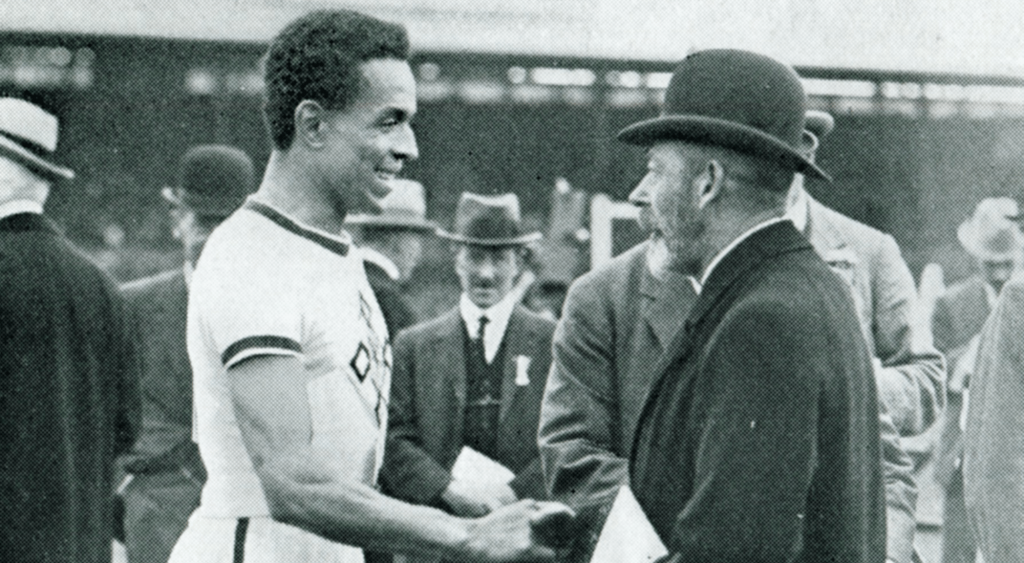
The reality is that for those AAAs in 1921 and 1922, Edward should have been introduced as an Olympic Champion instead of a double bronze medallist.
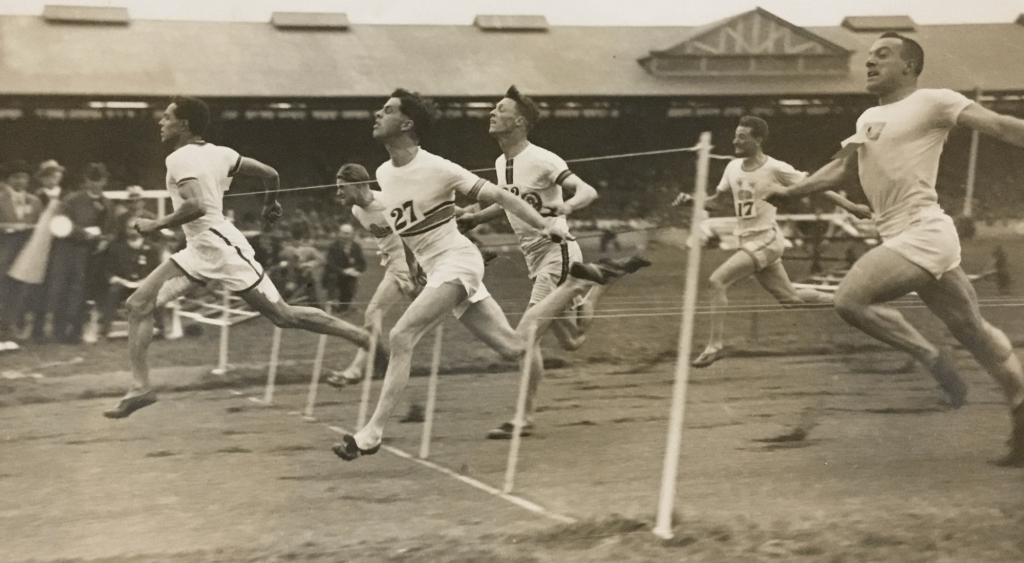
In Antwerp in 1920, American favourite Charley Paddock earmarked the Briton as his main rival for gold. Edward was feared by all and with good reason. After winning his quarter- and semi-finals, many expected him to win gold. In the final, Paddock went through a familiar pre-start ritual prior to the gun. It was misinterpreted by the assistant starter who crucially failed to order a recall – which almost certainly would have happened in any modern-day final. When the race started, Edward was left motionless, while Paddock blasted down the track to win in 10.8 seconds (the same time Edward ran in quarters and semis). The Briton finished like a steam train, coming through for bronze, the first Olympic medal won by a black British athlete.
In the 220-yards, Edward again won his quarter final, but pulled his hamstring in the semis, running the final with heavy strapping on his leg, securing a brave bronze.
Life after athletics
Antwerp was to be his only Olympic Games, but not the end of his extraordinary contribution to the world.
In 1923, less than a year after his AAAs hattrick, Edward emigrated to America, spending the rest of his life living in New York and working in civil rights, diplomacy and the theatre.
A true citizen of the world and a pioneer of British sport, England Athletics is proud and humbled to induct Britain’s first black Olympic medallist into the Hall of Fame.
Harry's story above has been compiled by Rob Walker, with images from Neil Duncanson.
Get your Hall of Fame 2026 tickets