Club Support round-up: our newly-expanded team, here to help
Over the last quarter, more of our Club Support Team have been travelling up and down the country to visit our affiliated clubs in person.
Our Club Support team is based across the regions to work directly with clubs on their own development. We offer practical advice, guidance, and resources, and we create opportunities for clubs to connect, learn from each other, and share good practice.
This month, we are delighted to introduce three new Club Support Managers:
- Victoria Eames: North East (full time) veames@englandathletics.org |07803671969
- Rachel Scott: East Midlands (full time) rachelscott@englandathletics.org | 07718394753
- Lee Bessent: London (full time) lbessent@englandathletics.org | 07770024533
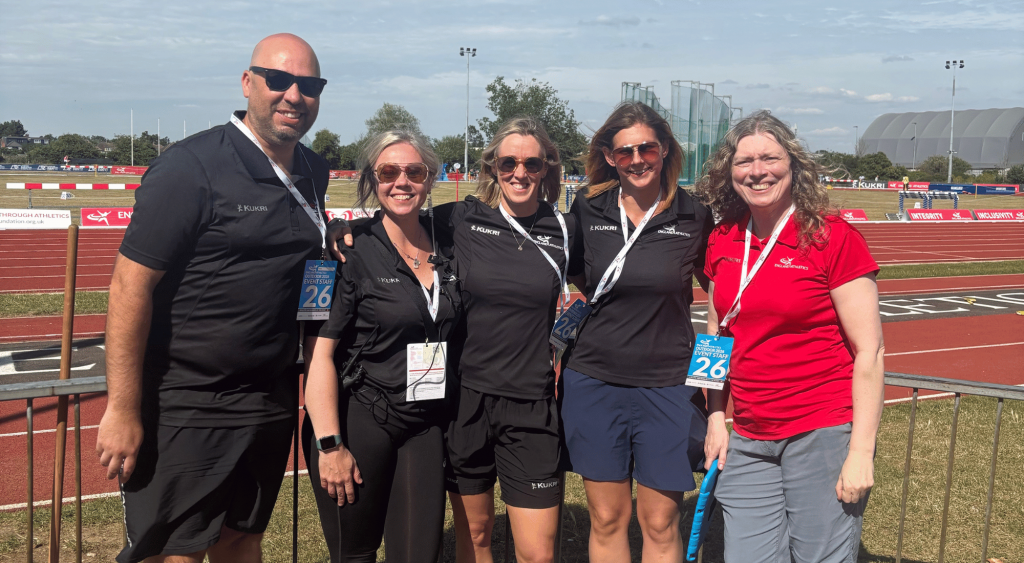
(Left to right: London Club Support Manager, Lee Bessent; Head of Competition and Partnerships, Nichola Skedgel; Head of Club Support, Emma Hurst; North East Club Support Manager, Victoria Eames; East Midlands Club Support Manager, Rachel Scott)
As part of our ambition to provide outstanding advice and guidance to affiliated clubs, the Club Support team acts as the main point of contact for club development matters across the regions. To help us understand the needs of clubs and continually improve the support we provide, we regularly review the themes and enquiries received by the team.
Between April and June, the key themes clubs contacted us about were:
- Club development
- Coaching structures/practice
- Club Standards
- Safeguarding
- Facilities
We also sought feedback from clubs on the support they received. The feedback highlighted the positive impact of the team's advice and guidance, with clubs commenting that:
- “The team I have had contact with (Kirsty and Megan) are a credit to EA and I am so grateful for their support to help me with our vision for future development.”
- “We feel we are very well supported by England Athletics.”
- “Very professional and very knowledgeable, great to know you guys are here to help me and the club.”
This insight helps us ensure we continue to deliver high-quality, responsive support that meets the needs of affiliated clubs.
Some more key takeaways from the results of our feedback survey included:
- An 86% satisfaction score
- 85% of people feel extremely/very supported by the Club Support team
- 66% of people feel very/quite positive towards England Athletics
Let's have a look at a key example of club support our team have provided over the last quarter:
Region: South East
Club: Oxford City AC
Club Support Manager: Ffion Edgeley
Oxford City AC, as operators of the Horsepath Road Athletics Track since 2018, identified a growing governance and operational risk as demand for facility hire increased without formalised processes in place. With schools and independent coaches regularly seeking access to the track, the absence of a standardised hire agreement and booking system was beginning to create conflicts in usage, confusion for users, and potential liability exposure for the club.
At the same time, recent changes within the club’s committee - including the introduction of new welfare officers and trustee updates - created a timely opportunity to strengthen their overall governance framework. Recognising the importance of getting this right, the club proactively engaged with England Athletics for support.
Through coordinated discussions and a detailed review of the draft risk assessment and hire agreement, tailored support was provided to sense-check documentation and ensure it aligned with best practice. This included identifying areas where additional specialist input would strengthen the club’s position, and signposting to UKA Health & Safety and legal support through Muckle. The club was also encouraged to utilise internal expertise from qualified professionals within its own membership, reinforcing a collaborative and sustainable approach.
Beyond immediate documentation improvements, the engagement opened up broader conversations around operational efficiency and modernisation. A key development was the exploration of implementing an online booking system, designed to centralise track usage, prevent double bookings, and ensure all users agree to terms and conditions at the point of hire. This approach not only reduces administrative burden on volunteers but also embeds stronger compliance and clarity for all users of the facility.
As a result, Oxford City AC now has a clear and informed pathway to strengthen its policies, improve safety and governance, and better manage facility usage. Importantly, the process has also established a positive working relationship with England Athletics, creating a foundation for ongoing support and engagement.
This example highlights the value of proactive club leadership, demonstrating how governance reviews, when supported appropriately, can mitigate risk, improve the participant experience, and support the long-term sustainability of club-operated facilities.
Region: West Midlands
Clubs: Birchfield Harriers, BRAT, Royal Sutton Coldfield AC
Club Support Manager: Scott Milne
Three Birmingham clubs have collaborated to design a new, localised series that prioritised the needs and experience of young athletes, following the implementation of the age group changes.
Through supportive guidance, the competition format was shaped to be age-appropriate, inclusive and centred on enjoyment, ensuring children could experience running, jumping and throwing in a safe and positive environment. Delivered across three local venues, the series also reduced travel demands, making it easier for families to take part.
The impact was immediate. The opening event created a fun, welcoming atmosphere where young athletes were able to try competition for the first time without pressure, building confidence, enjoyment and a sense of belonging in the sport. Alongside this, opportunities for young leaders and developing officials added to the supportive environment around the athletes.
This work demonstrates how collaboration between clubs can directly enhance the athlete experience, creating accessible, enjoyable competition that encourages long-term participation and a strong first connection to athletics.
Region: East
Club: Coltishall Jaguars Running Club
Club Support Manager: Kirsty Fardell
Following engagement in the Club Leadership Programme, Coltishall Jaguars identified the need to strengthen their long-term planning and governance to sustain a thriving, community-focused club.
Targeted support helped the club prioritise key areas including developing clear vision and values, improving succession planning, and gathering member insight through a survey. Practical steps were also outlined to share responsibilities, document processes, and address skills gaps in areas such as social media and communication.
As a result, the club now has a clear 6–12 month plan focused on stability, sustainability, and maintaining a strong member experience. By taking a proactive approach to leadership and planning, Coltishall Jaguars are better positioned to support their current membership while ensuring the club remains well-run, inclusive and community-driven in the long term.
Region: Yorkshire & Humber
Club: Goole Youth Athletics Club
Club Support Manager: Heidi Bradley
The redevelopment of Victoria Pleasure Ground presented a significant risk to both the future of Goole Youth Athletics Club and the provision of accessible athletics facilities within the local community. Ensuring the club could continue to operate, while also influencing the long-term facility design where possible, was critical to sustaining participation and athlete opportunities.
Targeted support was provided in collaboration with facilities expertise to advocate for the inclusion of athletics within the redevelopment and to maximise the usability of the space. This included supporting discussions with project stakeholders to reflect needs of clubs in the area. As the site reopened, further engagement has taken place regarding the safe and effective shared use of the facility, alongside consideration of equipment and ancillary provision.
Alongside facility work, support focused on strengthening the club’s coaching workforce following the loss of a long-standing coach. An interim plan ensured sessions continued, while funding enabled the development of a new qualified coach, increasing the club’s capacity to deliver a broader athletics offer.
As a result, the club has maintained continuity through a period of significant change and is now in a stronger position to grow. With facility access, increased coaching capacity, and ongoing support around equipment and infrastructure, Goole Youth Athletics Club is well placed to provide sustainable, high-quality opportunities for athletes within the local community.
Region: South West
Club: Bristol & West AC
Club Support Manager: Rich Ayling
As part of wider governance improvements, Bristol & West AC identified an opportunity to strengthen how young people shape and experience track and field activity. While the club already delivered a strong junior offer, there was a clear ambition to better reflect the voices of younger athletes and modernise the environment to make it more inclusive, engaging and development-focused.
The Club Support Manager played a key coordinating role, bringing together the club and Wesport to design a practical approach to embedding youth voice. This included shaping a Youth Ambassador programme, aligning it with the club’s structure, and providing guidance to ensure it complemented broader priorities such as athlete development, retention and positive competition experiences. Support also linked youth insight with the delivery of initiatives like funetics Multi-Challenge, helping to adapt and soften the traditional track and field environment for younger age groups.
The impact is already evident. Five Youth Ambassadors are now actively supporting sessions and events, helping to create a more relatable, welcoming and less pressured environment for younger athletes. This is contributing to a more modernised track and field experience - one that balances structure with fun, reduces barriers to participation, and builds confidence in early competition settings.
By embedding youth voice into both delivery and decision-making, the club is creating a more responsive and athlete-centred culture. This not only enhances the immediate experience for young members but also supports long-term engagement, leadership development, and a more sustainable future for the club.
Region: North West
Club: Blackpool, Wyre & Fylde AC
Club Support Manager: Sarah Friday
Following sustained club growth, Blackpool, Wyre & Fylde AC identified increasing pressure on a small, dedicated coaching team, alongside growing waiting lists. This presented both a risk to volunteer sustainability and a barrier to accommodating new and younger participants.
Through ongoing discussions, tailored guidance was provided to help the club explore a range of delivery models. This included developing their coaching and volunteer workforce, strengthening community connections, and considering the balance between volunteer-led and paid provision. The focus was on identifying a solution that would expand capacity without placing further strain on existing volunteers.
By connecting directly with the club at a local event, new prospective volunteers were identified who were motivated to support younger age groups. Working collaboratively, the club explored practical options before deciding to introduce funetics, alongside the potential of funetics Multi-Challenge as a future competitive pathway.
Targeted introductions to the funetics team supported the club to implement the programme, which is now underway and being delivered by new volunteers. This has enabled the club to take immediate action to reduce pressure on its core coaching workforce while creating a clear development pathway for younger athletes.
As a result, the club has strengthened its volunteer pipeline, diversified its offer, and taken a proactive step towards long-term sustainability. The approach not only protects existing volunteers but also positions the club to better manage demand, support participant growth, and build a more resilient and future-focused workforce.